

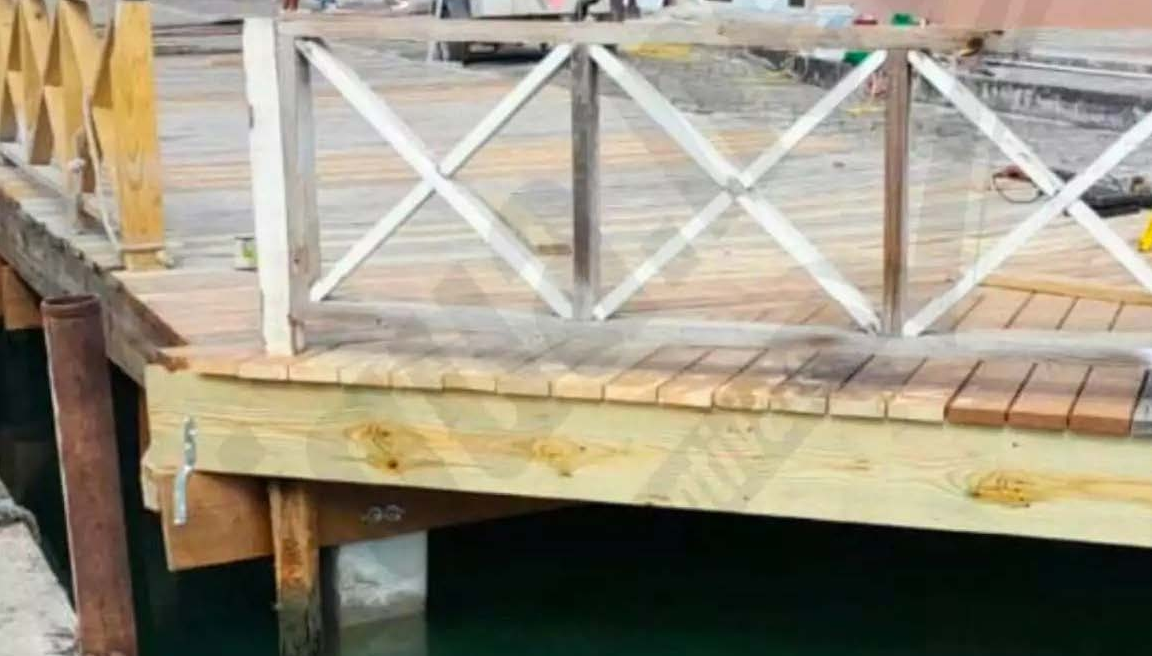

Pedestrian access has been partially restored along the St. John’s Harbour boardwalk following emergency stabilisation work, allowing the route between Redcliffe Quay and Heritage Quay to reopen under controlled conditions during the peak cruise season.
Port officials confirmed that the damaged section has been temporarily reinforced, allowing only pedestrian traffic while longer-term structural solutions are developed. The controlled reopening is intended to ease congestion along the harborfront while maintaining public safety during periods of heavy visitor traffic.
Port Manager Darwin Telemaque said the Antigua Port Authority has assumed full responsibility for the boardwalk’s management and maintenance, a move intended to strengthen oversight and accelerate necessary upgrades.
Quay Properties previously managed the boardwalk, but Telemaque said the Port Authority’s assumption of responsibility enables a more coordinated approach to inspections, safety enforcement, and long-term planning.
As part of the immediate response to the incident, water taxi operations were temporarily relocated to the Montserrat Ferry Terminal to ease congestion along the harborfront and reduce pressure on the weakened section of the boardwalk.
Telemaque noted that a comprehensive inspection and redesign are being fast-tracked, with engineers assessing load capacity, usage patterns, and structural integrity to ensure the boardwalk can safely meet modern cruise-era demands.
According to Telemaque, part of the redesign process will involve clarifying how different sections of the boardwalk are used, particularly where pedestrian flow intersects with commercial activity and marine operations.
He explained that certain sections were never intended for concentrated passenger traffic or water-taxi activity, making clear design standards and controls critical going forward.
The Port Authority will continue to closely monitor the reopened section as cruise calls remain heavy throughout the winter tourism season.
Beyond the immediate repairs, the boardwalk incident underscores the broader reality facing Antigua and Barbuda’s cruise infrastructure: visitor volumes have exceeded the original design assumptions for several legacy waterfront assets.
The Port Authority’s decision to assume direct responsibility for the boardwalk signals a shift toward more centralised oversight of cruise-facing infrastructure, with safety, load capacity, and usage clarity taking priority over informal or inherited arrangements.
It also underscores the need for infrastructure planning that aligns with modern cruise operations, including clearer pedestrian routing, designated loading areas for water taxis and tours, and materials engineered to withstand sustained, high-density foot traffic.
As cruise arrivals remain a key pillar of the tourism economy, the episode serves as a reminder that maintaining a positive visitor experience depends as much on behind-the-scenes engineering and asset management as on hospitality and marketing. Proactive investment and coordinated oversight will be essential to ensuring that port growth is matched by on-the-ground resilience.
The emergency intervention followed the collapse of a section of the boardwalk earlier this week, between Redcliffe Quay and Heritage Quay, on a busy cruise day when more than 12,000 visitors were on the island.
Reports indicate that at least two tourists were injured when the structure failed, and at least one fell into the water. Engineers and maintenance crews were deployed immediately to stabilise the area and prevent further damage.
Although no fatalities were reported, the incident has underscored the pressures on downtown harborfront infrastructure and the importance of proactive maintenance, clear usage designations, and timely upgrades in high-traffic public spaces.

